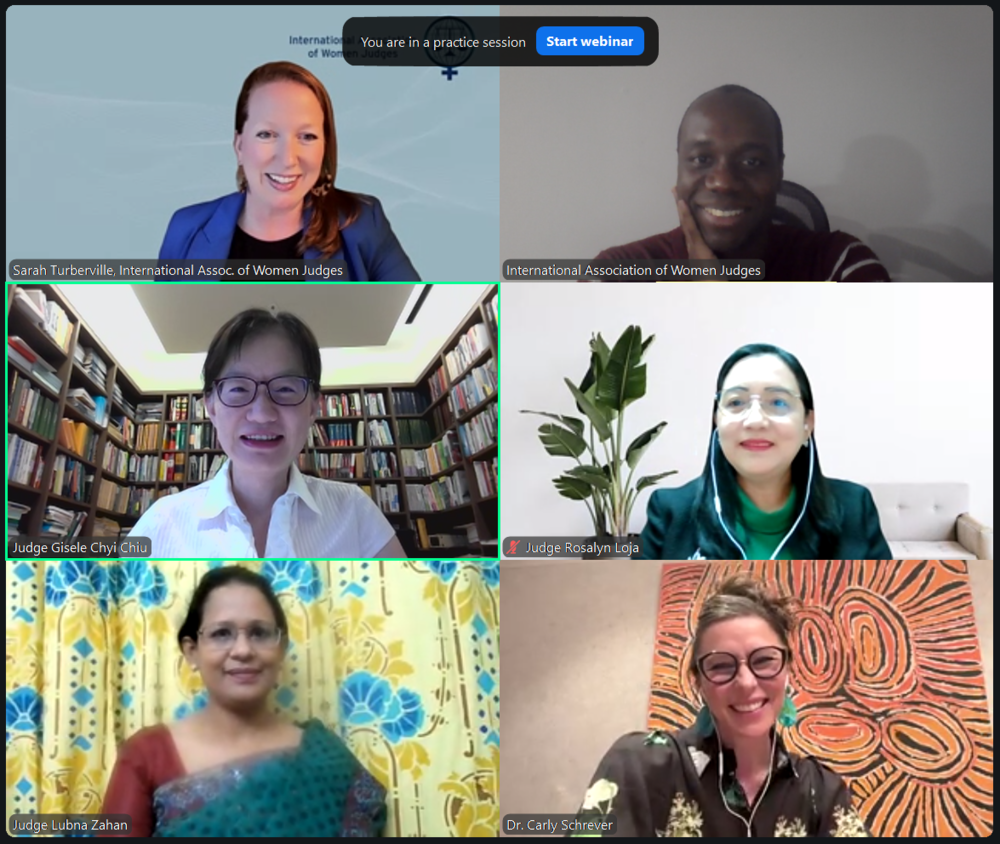
 On World Mental Health Day, the International Association of Women Judges (IAWJ) hosted “Balancing the Scales: Prioritizing Mental Health and Well-being of Judicial Officers,” a panel that critically explored the threats, opportunities, and underexplored influence of gender inequality on the mental wellness of women that grace the bench around the world.
Sarah Tuberville, executive director of the IAWJ, set the stage for the event by outlining the need to have conversations around broad threats to judges’ mental wellbeing– including extensive workloads, concerns around retribution, and the sense of ownership over high-stakes decisions– and their trickle-down effect on the health of legal systems and all parties involved in them.
She also highlighted how growing calls for acknowledgment of these issues culminated in the United Nations recently designating July 25 as the International Day for Judicial Well-being. The designation stemmed from the passage of the Nauru Declaration on Judicial Well-being exactly one year prior, and was supported almost unanimously by 160 member countries.
Notably, Carly Schrever, a lawyer, Director of Human Ethos, and the event’s keynote speaker, assisted in drafting the Nauru Declaration. Her address, which began shortly after, was largely grounded in the unprecedented research she and her colleagues conducted on the overarching and nuanced stressors judges face, how those manifest into actions they take both in and outside of the courtroom, and the value of understanding and rectifying those stressors.
She explained that this area of research came on the heels of decades of literature that largely highlighted the prevalence and severity of mental health ailments affecting lawyers, posing questions about how those at the highest ranks of the legal industry were impacted by them. She also clarified that, while she was observing the Australian judiciary, her findings transcended most international borders, barring countries with significant sociopolitical crises or issues.
Major takeaways from her investigations included that 20% of judicial officers actively experienced burnout, while 30% reported alcohol consumption at rates considered problematic by health experts.
Perhaps most significantly, approximately 30% of judicial officers scored in the range within a standardized measure of secondary traumatic stress, indicating the potential of post-traumatic stress disorder (PTSD)— six times the rate of diagnosed PTSD in most of the world.
The causes for the distress included previously noted causes like discrimination, heavy workloads, and isolation, as well others, such as demonization by the public, proximity to communities engaging in litigation, and what the researchers dubbed “stressors of injustice,” or the sense of being complicit in a system that perpetuates, rather than rectifies, injustices.
These challenges to mental health manifest outwards in more biased and hazier decision-making, chronic exhaustion, and a dissolution of their relationship to their sense of purpose and pride– often a key anchor for judges navigating difficult cases or circumstances.
“Judicial wellbeing is not only, or even principally, about the occupational health and happiness of judges,” Schrever said. “It's inextricably linked to judicial integrity and the quality of justice delivered. As we said before, the judiciary is a human system. And as a human system, making moral decisions that significantly impact people's lives, the psychological health of the human beings making those decisions is critical to the integrity of that system.”
The event then moved onto a roundtable discussion exploring the externalization of these topics through a global lens, featuring insights from Schrever, Gisèle Chyi Chiu, High Court Judge and member of the IAWJ’s Chinese Taipei chapter, Rosalyn Loja, judge of Regional Trial Court (RTC) of Manila Branch 41, and Lubna Zahan, additional district judge of the Judiciary of Bangladesh.
All three judges shared their lived experiences with gender discrimination in their respective judiciaries and how it impacted their mental health.
A recurring point across all of their remarks included how stereotypes regarding a woman’s familial obligations and traits– such as being more emotional than rational, too weak, or conversely, too assertive– affected their professional, mental and physical wellbeing.
All three judges reported being made to feel as though they have to meet a higher threshold of professionalism, competence, and success because of those inherently patriarchal beliefs. These imbalanced expectations for women on the bench, coupled by intentionally limited access to opportunities for advancement in the form of networking, mentorship and promotion behind the scenes, causes them undue stress and isolation.
“Judges are not invincible with the title we have, because we also need to seek relief for liberation from all these kinds of challenges,” Loja said. “Stereotypes can erode respect from colleagues, litigants and even court staff, subtly undermining a woman judge's authority and credibility when it comes to institutional cultures that marginalize women's experiences, workplaces may normalize long hours, emotional detachment and hyper rationality, traits which are historically coded as masculine while undervaluing empathy, rational relational intelligence and collaborative leadership.”
Loja also spoke about intersecting layers of discrimination judges may face in the Philippines for their socioeconomic position, religion, or region of origin.
The three judges then shed light on how they personally navigate these stressors, institutional shifts have assisted them, and what progress is left to enact.
At an individual level, Loja and Zahan shared that time management, friendships and social support outside of the industry, and organization were key pillars to maintaining their mental wellbeing. Zahan also pointed to self-care, hobbies, and boundary setting as other tools for mental wellness.
Meanwhile, Chiu shared how women judges in Chinese Taipei’s High Court refer to each other as “sisters” and informally meet with one another in the corridor to check in with one another and provide guidance on work-life balance and the unique challenges associated with being a woman judge. She also spoke about aromatherapy sessions and coffee workshops hosted by her IAWJ chapter to facilitate mental wellness and community connection.
“(These) gatherings were not trivial,” she said. “They reminded every women judging that it is okay to pause, to breathe and to restore lessons of community… to relax and share is the foundation of resilience.”
Institutionally, Zahan called on judiciaries and allies to recognize the importance of judges’ mental wellbeing, transparency, equality, and security, and to implement measures in line with those qualities, including mental health resources, equity-related programming, mentorship and other professional development opportunities, counseling programs, wellness interventions and safe spaces.
“Women in the judiciary face distinctive mental health challenges, but with robust peer networks, institutional commitment and practical strategies, we can create an environment where they do not just survive the demands of the role, but truly thrive when the judiciary supports the wellbeing of women, it strengthens not only the individuals, but also the justice system as a whole.
Some of these measures exist in judiciaries like Loja’s and Chiu’s. Loja shared about how the Filipino judiciary enacted tools like mental healthcare units and helplines, emotional self-regulation workshops, funded wellness leaves and medical care, guidelines for courtroom etiquette and equity, and a screening program that can identify early stages of burnout, while Chiu discussed how the Taipei judiciary introduced a no-questions-asked mental health leave program.
Schrever rounded out the discussion by pointing to the distinction between internal and external stressors, and the types of responses each warrants. Intrinsic stressors, difficult to truly eradicate, need to be addressed through acceptance and management. Meanwhile, extrinsic sources are better rectified by institutional prevention.
“Extrinsic sources of stress, they're not actually necessary for the performance of the judicial function,” she said. “Often, institutions are thinking about how they can help judges respond by providing counseling, mindfulness training, that sort of thing. And it's really important, but when so much of the stress comes from teachers in the environment that can be tackled institutionally, like how workload is managed, like how leadership consults and makes decisions, like tackling the cultural messaging about stress within the institution… if we can think about how we can prevent those at an institutional level, it goes a long way in reducing stress.”