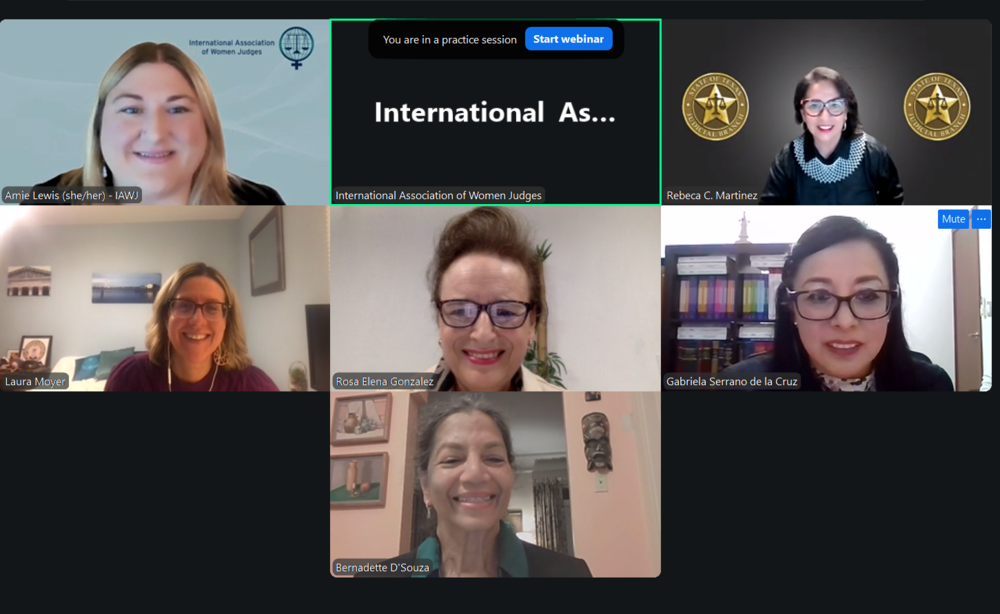
 The 2nd webinar in the She Runs for Justice: Campaigning, Communications, and Confronting Gender Bias series, hosted by the International Association of Women Judges’ WILIL program, was virtually held on the evening of November 6th, 2025. The webinar featured a panel of women judges and scholars from Mexico and the United States. This webinar series examines gender bias in judicial election processes, highlighting the unique risks and forms of discrimination that women judges often encounter during their campaigns. She Runs for Justice aims to confront how biases can undermine equity and fairness in the election process and provides women judges and scholars a space to discuss about their insights and experiences with this phenomenon.
The webinar’s keynote speaker, Judge Bernadette D'Souza, was elected as the first family court judge on the Civil District Court in Orleans Parish; Judge D’Souza is also a current IAWJ regional board member representing North America. For the panel discussion, speakers included: Magistrate Rosa Elena Gonzalez Tirado, Retired Judge of the Regional Plenary Court for Administrative and Civil Matters, Central-South Region, based in Mexico City; Judge Gabriela Serrano de la Cruz, Third District Judge in Civil and Labor Matters in the State of Nuevo León, based in Monterrey; Chief Justice Rebecca C. Martinez, Chief Justice in Austin, Texas; and Professor Laura Moyer, Professor of Political Science at the University of Louisville. Gender bias can affect the public’s attitude towards women judicial candidates and judges everywhere, regardless of country. While each country’s judicial selection process differs, there are striking similarities in how women’s experiences as candidates diverge from those of men. Women are often required to navigate additional pathways to gain public support—challenges rooted specifically in gender—which is precisely what brings this discussion to the forefront.
Chief Justice Martinez touched on how women being able to serve on the bench helps to improve the public's confidence in the judiciary. She explained how women candidates tend to be judged by things other than their qualifications and competency. The public tends to focus more on their appearance or likability, which should not be the focus in determining how well they would perform in their service for the judiciary. Magistrate Gonzalez highlighted similar points, explaining that women face many formal, factual, and/or substantive barriers for a judicial appointment that cost them a lot of work, dedication, effort, sacrifice, and study. Judge Serrano de la Cruz shared how she learned to gain support networks in unconventional ways, and how she sees the biggest challenge being impartial in the face of the need to obtain votes.
Professor Moyer highlighted how intersectionality, particularly the intersections of race and gender, shapes voter perceptions and choices in judicial elections, a dynamic that is too often overlooked. She noted that voters bring both gendered and racialized assumptions to their judgments about who is considered qualified. For example, women of color are far more likely to feel pressure to demonstrate additional professional experience, such as having previously served as a state court judge, to be viewed as equally qualified as their white or male counterparts. Professor Moyer also underscored that women judicial candidates face heightened negativity during their campaigns, including more frequent online trolling, incivility, and other forms of public hostility compared to men.
Panelists shared the obstacles they personally faced in their own election campaigns. Obstacles such as the discourse of constant rejection, emotional tolls, campaign expenses, and so much more affected how they navigate their campaigns. There are major structural and institutional inequities and women judicial candidates are forced to find a route through these inequities to have a successful campaign, whereas men are not required to jump through as many hoops.
The webinar included a discussion on voter behavior, emphasizing how public reactions to specific campaign strategies can significantly influence outcomes. Professor Moyer highlighted that having clear signals—such as endorsements from incumbents or high-profile supporters—can be a decisive advantage in elevating a candidate’s visibility and credibility. One of the problems with judicial elections, she pointed out, is that “in a space where voters have very little information about you, they're going to fall back on all kinds of things, that might not be the right kind of thing or might not be about all of your qualifications, and that's not your fault.”
The second webinar in the She Runs for Justice: Campaigning, Communications, and Confronting Gender Bias series explored key issues related to bias in judicial elections, drawing insights from the experiences of judges in both Mexico and the United States. Panelists shared strategies going forward that may help, including enforcing community and utilizing the different businesses, consultants, and experts that are out there to help. With all the challenges these candidates face, it is imperative that they have some backing and encouragement from people in their close communities. Moreover, panelists discussed the importance of connecting with mental health counselors to deal with trolling, online harassment, doxing, and so on during campaigns. Staying informed and knowing how to respond to bias can make a meaningful difference. Professor Moyer concluded with a message that resonated across the room: focus on what you can influence. Rather than dwelling on what lies beyond our control, she encouraged participants to channel their energy into actions that can drive change today and help shape a more equitable future, wherever they may be.