Global Justice 50/50 Unveils Landmark Report on Gender Equality and Justice
By: Ayra Soliman
International Association of Women Judges
Women in Leadership in Law Program Coordinator
Introduction
In a global climate defined by politicized judicial systems, narrowing access to rights, and a growing backlash against gender equality, the question of who defines justice has never been more urgent. To address this, Global 50/50, an independent, evidence-driven think tank, recently launched its Global Justice 50/50 Inaugural Report: A Conversation on Gender, Power, and the Justice Institutions That Shape Our Lives. The launch event convened a panel of international legal luminaries to discuss the report’s findings and integrate lived experiences.
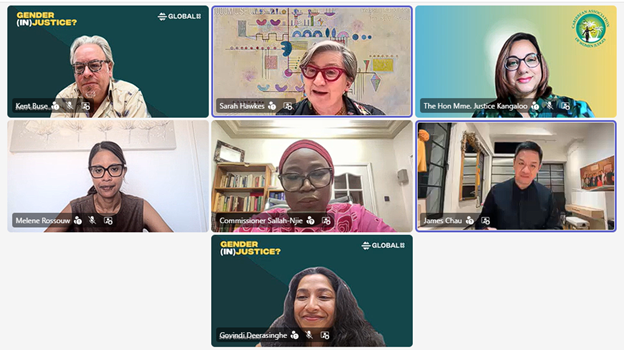
The event featured Govindi Deerasinghe, LLM, Justice Sector Lead at Global 50/50; Hon. Janet Ramatoulie Sallah-Njie, Vice Chair of the African Commission on Human and Peoples' Rights and Special Rapporteur on the Rights of Women in Africa; Hon. Madam Justice Nadia Kangaloo, High Court Judge in the Judiciary of the Republic of Trinidad and Tobago and President of the Caribbean Association of Women Judges; and Melene Rossouw, LLM, founder of the Women Lead Movement. Prof. Kent Buse and Prof. Sarah Hawkes, co-CEOs of Global 50/50, also shared insightful reflections on themes of accountability and call for action. Moderated by James Chau, the conversation tackles evidence and accountability, driving progressive change across the justice sector.
The Global Justice 50/50 Inaugural Report
Background and Scope
The Global Justice 50/50 initiative represents a significant expansion of the accountability model pioneered by Global 50/50 in the health sector over the last eight years. This evolution responds to a 2018 call from Amina Mohammed, Deputy Secretary-General of the United Nations, to replicate gender-related policy analysis across other sectors to advance the Sustainable Development Goals (SDGs).
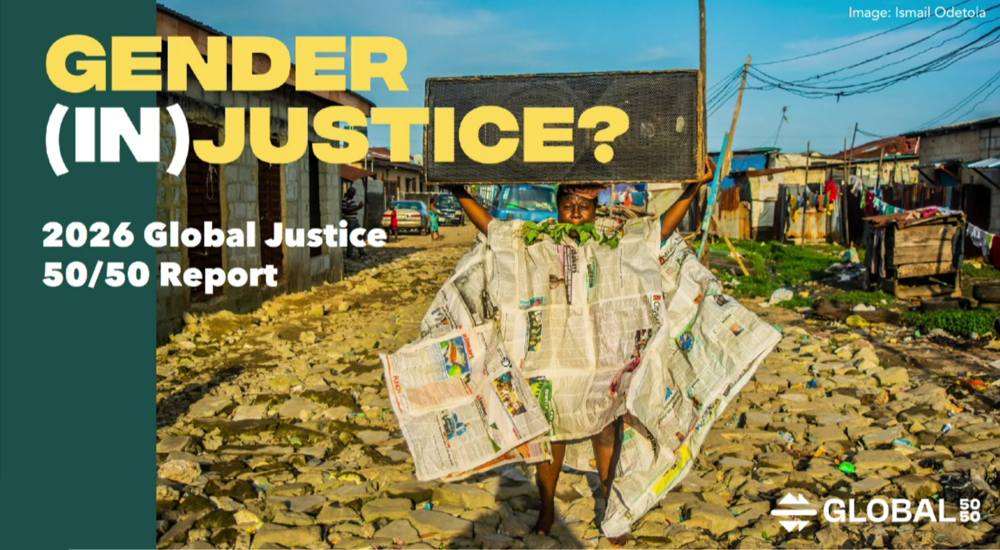
The 2026 report analyzes 171 organizations across seven diverse subsectors: global and regional courts, commissions and expert mechanisms, intergovernmental organizations (IGOs), international NGOs, law firms, legal professional associations, and funders. By examining six core variables -- including public commitments, workplace policies, and leadership demographics -- the report seeks to determine if these organizations "walk the talk" of the equality they champion externally.
Key Findings: The "Hubs of Power" Lag Behind
Govindi Deerasinghe presented the report’s headline findings, which revealed a stark disconnect between rhetoric and reality. While 54% of the 171 organizations assessed make a public commitment to gender equality, only 44% have publicly available policies with specific measures to achieve it.
The data on leadership is even more revealing. Across the entire sample, women hold 40% of the highest offices and 43% of senior roles. However, Deerasinghe noted that this parity disappears in what the report terms the "traditional hubs of legal power". In global and regional courts, women hold only 29% of the highest offices; in legal professional associations, that number is 30%, and in internationally operating law firms, it drops to just 20%.
Geography and intersectionality further complicate this picture. The report found that 81% of the highest office holders are nationals of high-income countries. Strikingly, while 25% of all highest offices are held by men from the United States, fewer than 1% are held by women from low-income countries. As Deerasinghe emphasized, "Global justice is disproportionately shaped by a small segment of the world."
Panel Insights: Systems More Than Presence
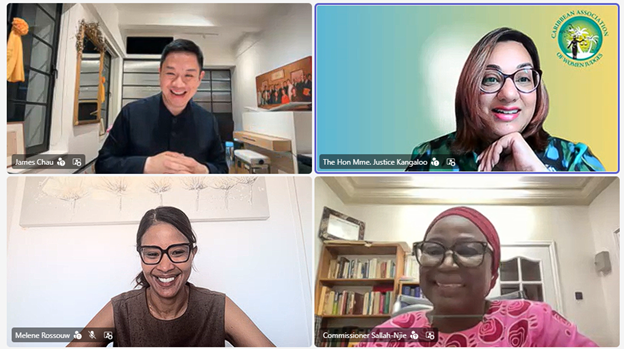
The panelists responded to these findings with reflections rooted in both data and lived experiences. Hon. Madam Justice Nadia Kangaloo provided a nuanced perspective from the Caribbean, noting that while women have entered the legal profession in "exponential" numbers, leadership cultures remain static. She pointed out that in Trinidad and Tobago, 74% of judicial officers are women, yet the nation has never seen a female Chief Justice.
Justice Kangaloo argued that the focus must move beyond mere representation to institutional support. "It’s not just about the representation," she stated. "It’s what we do when we get there and what is done to support us while we're there." She advocated systemic reforms rather than "individual coping mechanisms," stressing that the strength of a judiciary depends on the conditions under which justice is delivered.
Hon. Commissioner Janet R. Sallah-Njie expanded the discussion to the African context, highlighting how structural imbalances reproduce inequality from within. She noted that in many traditional and religious courts, where most African citizens first seek access to justice, women are entirely absent. "If people don't see themselves in institutions that are supposed to deliver justice for them, it might be difficult for them to have legitimacy," she warned. For Sallah-Njie, legitimacy is not a given; it must be "demonstrated" through responsive and representative decision-making.
Melene Rossouw offered a critical view on why these institutions struggle to change, citing the "protection of power" as a primary barrier. She argued that many organizations engage in "tick-box diversity policies" to remain compliant without actually driving transformation. Rossouw famously noted, "Presence is not power. What we do need is those women in leadership to actually have control over resources...they must have the ability to influence the agenda."
The Path Forward: Accountability and Action
The report and the panel discussion concluded with a clear call to move from aspiration to obligation. Prof. Kent Buse noted that the current global project seeking to reassert control over bodies and rights makes the justice sector a critical "battleground". He emphasized that "isolation is dangerous" and that the Global Justice 50/50 initiative is designed to be a space for shared evidence and solidarity.
Building on this call to action, the panelists identified several key levers for change: funders, civil society, and institutional leadership. Philanthropies must embed equity requirements into their funding criteria, linking resources directly to institutional performance on gender justice. Professional bodies and NGOs must maintain "sustained external pressure," using research, advocacy, and even litigation to hold institutions to their promises. Organizations must institutionalize "feminist leadership" that prioritizes transparent selection processes, workload reform, and the collection of sex-disaggregated data. Currently, only 18% of the organizations assessed commit to collecting and reporting sex-disaggregated programmatic data. As the report suggests, "What is not measured cannot be changed."
Conclusion
The inaugural Global Justice 50/50 Report serves as both a diagnostic and a stronger call for action. It reveals that the institutions responsible for upholding fairness and equity globally have yet to fully embody those principles within their own ranks. However, by providing the first systematic baseline, the report offers a practical tool for institutions to test themselves against evidence, recognize what works, and address what does not.
As Prof. Sarah Hawkes concluded, this work is about creating a "fairer global order grounded in international law". The report is not an end but a beginning -- an invitation for the global justice community to read, reflect, and act to ensure that the future of justice is as inclusive as the values it seeks to defend.
For readers interested, more information is available at global5050.org. Access the full report at global5050.org/2026-report-justice.