Beyond the Bench: Women Judges Reflect on Power, Legitimacy, and Access to Justice
By Ayra Soliman
Introduction
The International Day of Women Judges serves as more than a celebration of representation; it is a call to action for justice systems to reflect the societies they serve. In commemoration of this significant occasion on March 10, a global panel of distinguished jurists gathered for an insightful webinar titled “Women on the Bench and Beyond: Why, When, and How?” organized by the International Association of Women Judges.
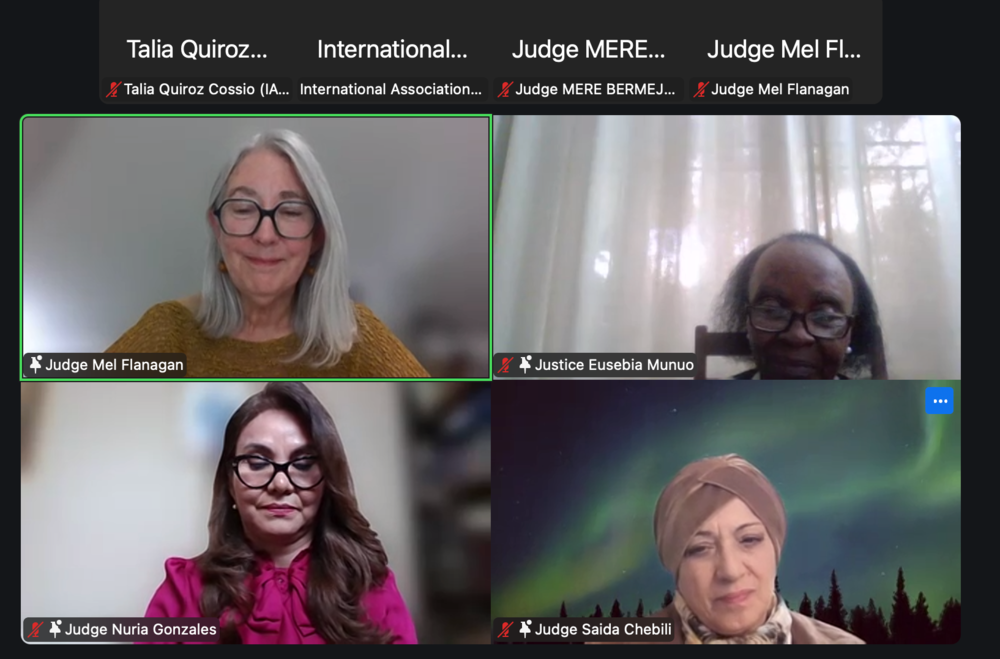
The event brought together women judges who have demonstrated exemplary leadership in the judiciary and beyond:
- Justice Eusebia Nicholas Munuo, Rtd. Justice of Appeal of Tanzania;
- Judge Mel Flanagan, Rtd. Judge for the Milwaukee County Circuit Court in Wisconsin;
- Judge Nuria Gonzalez, Rtd., Bolivia;
- Judge Saida Chebili, Rtd., Tunisia; and
- Judge Cristina Mere, President of the Court of First Instance of Irun.
Women Judges Beyond the Bench: Why, When, and How?
For decades, the standard judicial model dictated that a judge’s influence should begin and end at the courtroom door to preserve an aura of impartiality. However, as global societies face complex challenges -- from systemic corruption and gender-based violence to deep-seated implicit biases -- the panel argued that isolation is no longer a viable path to true justice. It must be innovative, with active, community-engaged leadership that strengthens the rule of law and ensures equitable access to justice for all.
The discourse on women judges beyond the bench focuses on three pivotal questions:
- Why is it essential for women judges to engage with the public?
- When does such engagement align with judicial ethics and independence?
- How can judges effectively contribute to their communities through education, partnerships, and institutional initiatives?
Round 1: The "Why"—Representation, Empathy, and the Battle Against Bias
The speakers agreed that the role of a judge extends far beyond the confines of the courtroom, arguing that social engagement is essential for representation, addressing structural inequalities, and fostering public trust in the justice system.
Justice Munuo asserted that failing to engage means failing "the women who look to us as examples." She argued that communities look to women judges for guidance, education, and advice on issues like human rights and the protection of vulnerable groups. This engagement strengthens access to justice by providing "representation, hope, and change" and proving that women can succeed in high-level judicial careers.
Judge Gonzalez and Judge Mere highlighted that courtroom work alone cannot address structural inequalities or the "structural crisis of justice." Judge Gonzalez believes engagement is necessary to demonstrate transparency and horizontal dialogue and to communicate institutional policies regarding access to justice. Judge Mere added that judges must stay connected to social realities because "social dynamics—such as stereotypes [and] prejudices" are often invisible from the bench. This external involvement builds trust in the justice system and fosters empathy, which Judge Mere argued "enriches our understanding of cases and contributes to a more humane application of the law."
Judge Chebili noted that the "rule of law alone cannot always capture the complexity of human situations." She advocated for engagement through mediation and dialogue to create a system that is more responsive, more equitable, and closer to the needs of society.
Finally, Judge Mel Flanagan explained that women judges often understand firsthand the experiences and challenges that women face, making them uniquely positioned to advocate for change. She stressed that such engagement helps mitigate "implicit bias" and "strengthens public confidence in the justice system" because individuals see themselves reflected on the bench.
Round 2: The "When"—Ethics and Independence
The speakers explained that judicial engagement aligns with ethics when it promotes "legal education," "public awareness," and "transparency" to build "public trust."
Justice Munuo asserted that outside the courtroom, judges act as “educators of the law” to improve community legal literacy. Similarly, Judge Flanagan argued that judges should be active and engaged members of their communities, serving as mentors who help citizens see the law as something that exists to protect and serve them.
The primary safeguard for this engagement is strict adherence to written codes of judicial conduct and ethics. Judge Gonzalez emphasized that while judges must be visible, they must use "institutional filters" and ethical standards to prevent corruption and protect the integrity of the system. Judge Chebili added that engagement must be thoughtful and deliberate, never impulsive, and should always aim to strengthen the rule of law. She characterized this professional involvement as "judicial diplomacy" that helps restore confidence in justice institutions.
Judge Mere however warned that judges must remain independent from partisan interests, specifically ideologies of political parties or trade unions. She further noted that engagement, such as expressing solidarity with colleagues, must never involve intervening in “any specific case.” Justice Munuo echoed this, stating a judge must decide cases objectively and without external pressure. Finally, Judge Flanagan reminded that judges must protect confidentiality and security and refrain from publicly discussing matters currently before the court.
Round 3: The "How"—Education, Mentorship, and Inclusive Language
The speakers emphasize that judges can contribute safely and effectively through associations, mentorship, and collaboration while ensuring these activities do not compromise their primary duties.
Justice Munuo explained that the Tanzania Women Judges Association schedules seminars and workshops during weekends or court vacations. She advocated for a "training-of-trainers" model and the use of moot courts to demonstrate judicial reasoning to the public, fostering community legal literacy.
Judge Gonzalez and Judge Chebili highlighted the importance of institutional engagement to build professional solidarity and drive judicial reform. Judge Gonzalez suggested forming “working groups and strategic partnerships with state institutions and civil society” to address the needs of vulnerable populations. Judge Chebili added that organizing public initiatives and exhibitions helps bring justice closer to the citizens, transforming the judge’s role into a "vocation" as a builder of justice.
To maintain safety and independence, Judge Mere asserted that collaborations must remain institutional rather than political, specifically avoiding direct involvement with political parties. She also emphasized mentoring younger generations to instill ethical standards and professional values.
Finally, Judge Mel Flanagan argued that effective contribution requires internal work, such as proper training on the impact of bias. She recommended using tools like a "bench card" to help judges check themselves against implicit bias, ensuring that their community engagement and judicial decisions remain thoughtful, careful, and deliberate. Through these structured institutional activities, judges act as mentors and educators without undermining the integrity of the bench.
Conclusion: A Shared Vision of the Women Judges Beyond the Bench
The insights shared during this event underscore a transformative shift in the global judiciary. The consensus is clear: for justice to be truly "just," it cannot be a distant, intimidating force seated high above the people. It must be accessible, empathetic, and representative. By engaging "Beyond the Bench," the future of the judiciary lies in this blend of rigorous legal expertise and active community engagement as women judges lead the way toward a world where the courtroom is not a place of fear, but a cornerstone of human dignity and equality.