Bridging the Justice Gap: Global Leaders Define Strategies, Pathways, and Good Practice for Women’s Empowerment at CSW70
By: Ayra Soliman
Introduction
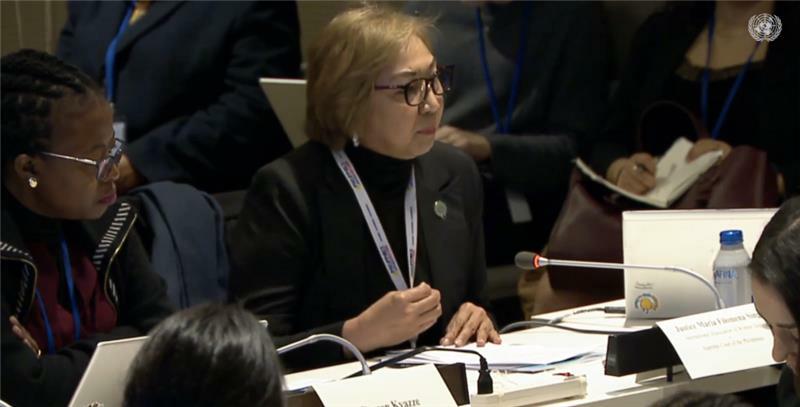
Justice Maria Filomena D. Singh, IAWJ President-elect
On March 16, 2026, global leaders, esteemed jurists, and advocates gathered at the United Nations Headquarters in New York for a high-level side event titled “Access to Justice for Women and Girls: Strategies, Pathways and Good Practice.” Organized by the International Development Law Organization (IDLO), with the support of the governments of Australia, Italy, and the Philippines, and in partnership with the American Bar Association (ABA) and International Association of Women Judges (IAWJ), the event formed part of the 70th Session of the Commission on the Status of Women (CSW70).
- Jan Beagle, Director-General of IDLO, moderated the discussion, which featured a distinguished roster of speakers, including:
- Hon. Ruth Cross Kwansing, Minister for Women, Youth, Sport and Social Affairs of Kiribati
- Hon. Majken Anika S. Gran-Ong, Undersecretary of the Department of Justice, Government of the Philippines
- H.E. Giorgio Marrapodi, Permanent Representative of Italy to the United Nations.
- Padma Raman, Executive Director of the Office for Women, Department of the Prime Minister and Cabinet, Australia
- Hon. Justice Maria Filomena Singh, Associate Justice, Supreme Court of the Philippines and President-Elect of the International Association of Women Judges (IAWJ)
- Tea Trumbic, Manager for Women, Business and the Law at the World Bank
- Doreen Kyazze, Regional Director for Sub-Saharan Africa, Penal Reform International
- Michelle A. Behnke, President of the American Bar Association
- Professor Rangita de Silva de Alwis, Member of the Committee on the Elimination of Discrimination against Women (CEDAW)
Together, these experts addressed the persistent and systemic barriers that prevent women and girls from claiming their rights by sharing innovative, evidence-based strategies, pathways, and good practice.
The Steps to Augmenting Access to Justice for Women and Girls
Access to justice is not merely a legal requirement; it is a fundamental enabler of sustainable development and human rights. It reflects the vital interdependence between SDG 5 (Gender Equality) and SDG 16 (Peace, Justice, and Strong Institutions). Despite its importance, however, the justice sector remains under-resourced, and the gender justice gap continues to grow. In response, the event emphasized the need for a holistic and multi-dimensional approach.
Legal Reform and Effective Integration of Global Frameworks
A primary strategy shared by several speakers is the necessity of comprehensive legal reform to eliminate discriminatory provisions and institutionalize protections for women and girls. Beagle noted that legal reform is essential to remove structural barriers to equality, particularly in areas like property, inheritance, and family law.
Professor de Alwis also emphasized that states must move beyond "de jure equality to de facto reality" by fully domesticating international standards like the Convention on the Elimination of All Forms of Discrimination Against Women (CEDAW) and General Recommendation No. 33. Ambassador Marrapodi likewise highlighted that "safeguarding women’s access to justice... requires sustained political commitment," noting Italy’s recent legislation that recognizes femicide as a specific crime of hate or discrimination.
Similarly, Raman pointed to Australia’s positive duty under its Sex Discrimination Act, which shifts responsibility from victims to employers by requiring proactive measures to eliminate workplace harassment. Together, these examples illustrate how aligning domestic laws with international standards can drive meaningful structural change.
Institutional Transformation and Responsive Justice Services
To ensure that laws are effective in practice, speakers advocated for transforming justice institutions to be more accessible and survivor-centered. Hon. Gran-Ong detailed the Philippines' use of a "priority pass system" for victims of violence to help them seek justice more confidently. Justice Singh also discussed the importance of the Justice Sector Coordinating Council, which integrates the judiciary, police, and prosecutors to prevent re-victimization at earlier stages through unified victim-sensitive guidelines.
With respect to women in the criminal justice system, Kyazze argued for non-custodial alternatives to imprisonment and gender-sensitive prison policies. She reported that the 24% increase in the number of women in prison across Africa is driven largely by the criminalization of poverty for offenses like street vending or failure to pay debts, while noting that 90% of these women are illiterate and unaware of their rights.
Looking ahead, both Raman and Professor de Silva de Alwis identified technology as a critical frontier, emphasizing the need to address technology-facilitated gender-based violence and to guard against the risk of artificial intelligence reinforcing existing biases. On this, Raman detailed the work of the eSafety Commissioner, which combats technology-facilitated abuse; a "courageous role" in making online spaces safer despite resistance from major tech companies.
Community Engagement and Legal Empowerment
Beyond institutions, the discussion highlighted the importance of bringing justice closer to communities, particularly for women in marginalized or remote areas. Beagle shared an example from Uganda where IDLO engaged 36,000 community members through mobile legal aid clinics and radio programs, which led to a significant increase in women taking legal action.
Hon. Kwansing emphasized that, in the Pacific context, justice initiatives must adopt survivor-centered, whole-of-community, and family-based approaches, while also engaging men and boys as allies. Meanwhile, Behnke underscored the critical role of the legal profession, particularly the need for trauma-informed training to better support survivors.
Together, these approaches demonstrate that legal empowerment at the grassroots level is essential to making justice systems truly inclusive and effective.
Economic Integration and Innovative Budgeting
Speakers linked justice to economic empowerment and innovative financial practices. Raman showcased Australia’s long history of gender-responsive budgeting, which ensures that every government decision is subject to gender analysis to improve outcomes for all genders. She also mentioned "justice reinvestment," which redirects funds from incarceration toward community-based interventions.
Trumbic pointed to the significant economic implications of gender inequality, noting that "if women had equal access to jobs globally, GDP could rise by as much as 20%." These insights reinforce the idea that justice is not only a legal or moral imperative but also a key driver of economic development.
Judicial Representation and Leadership
Finally, speakers identified the increased representation of women in judicial leadership as a transformative pathway. Justice Singh highlighted that while women are well-represented in lower courts in the Philippines, they remain a small minority in the Supreme Court, asserting that "the day should come when the appointment of a woman Chief Justice is no longer cause for celebration... because it is no longer extraordinary, but expected and earned." She also pioneered the "HerStory" initiative, a narrative change campaign that amplifies the voices and leadership pathways of diverse women judges across the Philippines, which further challenges stereotypes that women must sacrifice their personal lives for high-level judicial careers.
Professor de Alwis echoed the important role of women judges, stating that the presence of women judges has historically been "pivotal in recognizing rape as a tool of war" and reshaping evidentiary practices to restore dignity to survivors, citing the Akayesu case. Hon. Kwansing expanded this theme to intersectionality, noting that "real change will come when those who have lived these experiences," such as women with disabilities, "are at the forefront of shaping the solutions."
Conclusion
The discussion concluded with a powerful consensus: while the challenges are daunting -- ranging from discriminatory social norms to a lack of robust data -- the strategies for success are increasingly clear. To summarize, Beagle cited frameworks and evidence of what works, such as the integration of SDG 5 and SDG 16 and tools like gender-responsive budgeting, community legal empowerment leading to increase in women’s legal action in Uganda, and women’s assertion of inheritance and property rights in Afghanistan. But she advocated that while we have these improvements, the world needs the political will and adequate investment to scale these practices. She called for a whole-of-government, whole-of-community, and intersectional approach to ensure that justice is not a privilege for the few, but a right for all women and girls everywhere.
As the international community looks toward the upcoming Global Conference on SDG 16, the insights shared at CSW70 serve as a roadmap. By scaling up good practices like gender-responsive budgeting, specialized courts, and legal empowerment, the goal of a justice system that truly works for every woman and girl becomes an achievable reality.