Holding the Line: The Power of Self-Authorisation and Women’s Role in Reforming Global Justice
By: Thando Ntlabati
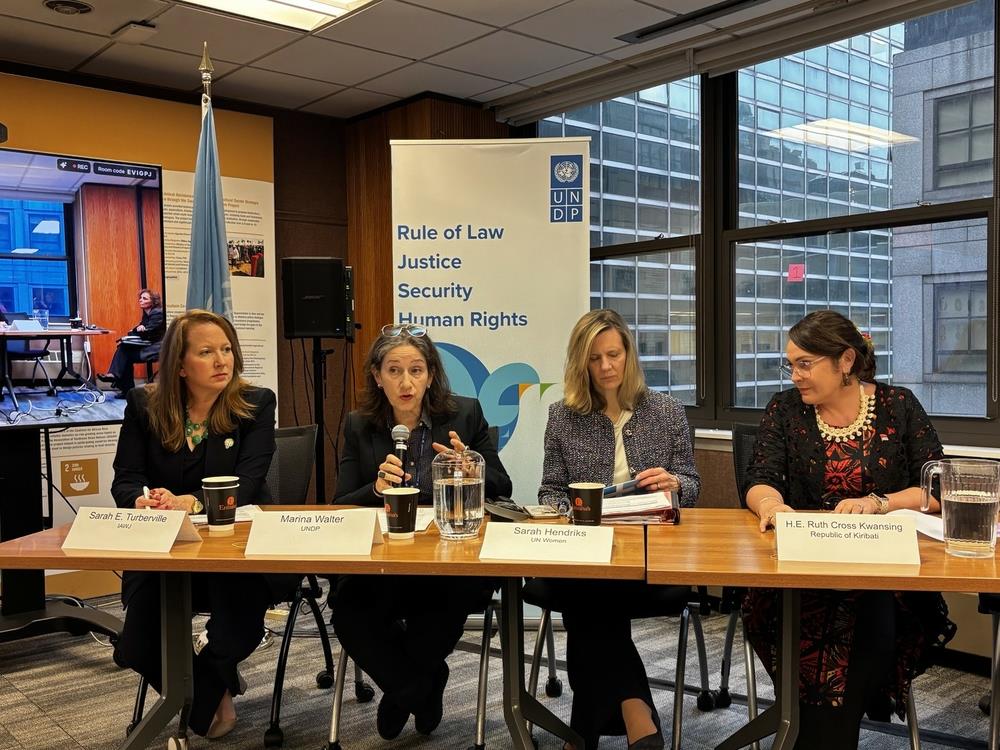
Photo: UNDP
In a global landscape defined by growing pressure and push-back on women’s rights, the United Nations Development Programme (UNDP), UN Women, the International Association of Women Judges (IAWJ) and the GQUAL Campaign, with support from the State of Qatar and the Permanent Missions to the United Nations (UN) of Germany, Netherlands, and Kiribati, convened a UN 70th Commission on the Status of Women (CSW70) side event, titled “Women Judges Holding the Line: Scaling the Gender Justice Platform for Women’s Rights and Access to Justice.” This event spotlighted how women in the judiciary are redefining the purpose of representation by going beyond filling seats to actively dismantling patriarchal legal architectures and driving systemic reform from within. It examined women’s access to and impact within international justice institutions, noting how women’s presence in these institutions has generated significant change through everyday leadership.
The esteemed speakers and panellists included:
- Marina Walter: Deputy Regional Director, UNDP Regional Bureau for Arab States
- Sarah Hendriks: Director, Policy, Programme and Intergovernmental Support Division, UN Women
- H.E Ruth Cross Kwansing: Minister for Women, Youth, Sports and Social Affairs, Republic of Kiribati
- Judge Dr. Hissa Al-Sulaiti: Judge at the Court of Appeal at the State of Qatar, Head of the Task Force on Enhancing Women’s Representation in the Judiciary
- Judge Taghreed Abdul-Majeed: Deputy President of the Baghdad Al-Rusafa Court of Appeal, President of the Financial Services Court, Head of the Iraqi Women Judges Association, Representing the Arab Women Judges Network
- Honourable Aisha Zumo Bade: Judge of the High Court of Tanzania
- Sarah Turberville (Moderator): Executive Director, IAWJ
- Amie Lewis: Senior Programs Officer, Women In Leadership In Law, IAWJ
- Claudia Martin: Co-Director, GQUAL Campaign, Professor, Academy of Human Rights and Humanitarian Law, American University, Washington College of Law
- Inken Denker: Head of Division, Feminist Development Policy, German Federal Ministry for Economic Cooperation and Development
The Gavel as a Lens: Identifying the need for representation
The theme of the event was poignantly captured by Minister for Women, Youth, Sports and Social Affairs, H.E. Ruth Cross Kwansing of Kiribati, who stated, "When women hold the gavel, the law begins to see women, too." She went further to note that in Kiribati, 38% of magistrates and 28% of legislators are now women. According to Minister Kwansing, this was no accident; “it occurred because women believed in their own rights and refused to accept that justice was not their domain.” It similarly signifies a call to stop treating women’s leadership as an exception, but the norm, as women continue to navigate systems that exclude them. In Kiribati’s case the "seeing" referred to earlier, requires an integration of lived experiences and cognizance of disproportionate climate disaster impact, as well as the recognition of limited networks, unpaid care work, structured promotional pathways and trauma-informed legal approaches; all factors that have historically been invisible to a male-dominated legal gaze. By redefining who the "user" of the justice system is, women judges ensure that institutions remain accountable to the entire society they serve. As confirmed by Honourable Aisha Bade, Judge of the High Court of Tanzania, it is precisely when women occupy these spaces, that "the user gets to be redefined," and subsequent interventions are designed from a gender-responsive perspective.
Speakers also highlighted the necessity of centring women and their narratives to understand what is happening. Deputy Regional Director of the UNDP Regional Bureau for Arab States, Marina Walter, set the current landscape well, stating how women and girls remain the most vulnerable and continue to face unequal justice systems which operate without their protection in mind. She further noted how these gaps are widest where data is most rare. Further, these gaps are even more evident in conflict regions, where “women’s rights are the first out the window when conflicts start.” The discussion acknowledged a general lack of female representation in the senior structures of judicial systems worldwide, emphasizing the presence of women in senior judicial roles, not as a secondary matter of symbolic equity, but a fundamental requirement for institutional legitimacy. When women are in the rooms where decisions are being made, gender parity becomes more than just a checkbox.
The Gender Justice Platform and Other Interventions
As part of a systems building endeavor, UNDP and UN Women have combined their expertise in strategic rule of law and gender equality imperatives to provide a high-impact framework that highlights women's leadership and role in international policy, advocacy, innovation, and learning. The Gender Justice Platform (GJP) brings together diverse stakeholders and gender equality champions, including States, civil society, academia, and UN agencies, that are committed to realizing justice systems that work for all women and girls. The role of the GJP is to protect women’s seat at the table by informing policy and positioning women as co-designers of programs instead of just subjects. It facilitates peer learning and collective leverage, as well as builds stronger reforms and methods of resource sequencing which create accountability tools that allow for measuring progress.
According to Sarah Hendriks, UN Women Director of the Policy, Programme and Intergovernmental Support Division, the most significant barriers have been in policy choices and political will. While countries like Tanzania and Kosovo have implemented various gender justice reforms and advocated for the recognition of unpaid care work and trauma informed approaches in litigation, data patterns reveal that justice sectors are spending less than 1% of national budgets on the necessary reforms. Hendriks ended her address by emphasizing the need to invest in women, stating, “The future is not fixed,” and that women judges are integral to the shift in building new ideologies.
Claudia Martin, Co-director of the GQUAL Campaign, also introduced the Voices from the Bench: Women Shaping International Justice report and emphasised that equal and inclusive representation is a fundamental requirement for institutional legitimacy and strengthens the credibility of international bodies. The inclusion of women as independent experts, judges, and the like, produces substantive changes in institutional practice and policy leading to more rigorous deliberation, healthier institutions, improved culture, and challenges to long-standing practice. Martin noted that the report provides growing evidence of how a diversity of perspectives on the bench improves judicial outcomes and strengthens the quality of justice delivered. A defining feature of her summary was a powerful collective message to future generations of women to "prepare relentlessly, support each other openly, lead with integrity, and widen the circle." Martin concluded that the objective for the next generation must go beyond mere entry into international spaces; they must actively reshape these institutions to ensure they are more just, inclusive, and reflective of the diverse world they are meant to serve.
Conclusion
The transformative work of women judges undoubtedly extends beyond individual brilliance; it is a collective institutional strategy. Using the IAWJ and its network as an example of the potential for success in this strategy, it can be seen how jurists are going beyond the bench to partner across the justice sector and transform the institutions they serve. These networks act as "platforms for transformation and knowledge," as Judge Taghreed Abdul-Majeed of Iraq explained, allowing for cross-border cooperation that enhances the role of women globally. As the event concluded, the consensus was clear: justice reform is not a short-term intervention but a sustained political and institutional effort. It requires "courageous women who stand up for their positions" and a global system that recognises that gender parity is a matter of legitimacy, quality, and credibility. By authorising their own leadership, these judges are simultaneously holding the line and redrawing it to ensure that the international legal space finally reflects, and effectively serves, the diversity of the world it protects.
Senior Program Officer for the Women in Leadership in Law (WILIL) initiative, at IAWJ, Amie Lewis, painted an inspiring picture of how women’s representation in judicial systems makes them function better. Lewis notes how across the globe and through the IAWJ’s WILIL initiative, “judges are going beyond the bench to transform judiciaries, working collectively with justice-sector partners to reform the institutions in which they serve.” Women judicial associations have demonstrated incomparable value by partnering across justice sectors in coalition and solidarity to make reforms more inclusive and accountable. The IAWJ WILIL pilot countries have exhibited countless successes, most notably the recognition of women judge’s associations as credible justice-sector actors and partners, and women judges themselves as catalysts for institutional change. In the Philippines, the Philippine Women Judges Association (PWJA) has been recognized by the Judicial Bar and Council (JBC) as an endorsing body to increase the number of women judges appointed to higher level courts and works in tandem with the Supreme Court Committee on Gender Responsiveness to implement an annual HerStory visibility campaign. In South Africa, transparency and accountability reforms, in partnership with the Office of the Chief Justice and the Magistrates Commission, have led to the adoption of a judiciary-wide sexual harassment policy and established criteria for the appointments of acting magistrates. Incentives for female judicial appointments, including robust data collection and an emphasis on gender parity, ending discriminatory indigeneity practices, and promotion of work-life balance initiatives such as court-adjacent creches in Nigeria, as well as a Collaborative Empowerment Network (CEN) in Kenya have focused on creating enabling environments for women to not only enter the judiciary, but to rise and thrive in it. The work of IAWJ highlights the importance of data and storytelling as well as the value of collective collaboration and alliance-building across the justice sector, particularly through engagement with civil society organizations.
Overall, the discussion emphasized the increasingly evident fact that women are not waiting for better systems to emerge but instead are building them every day. A central theme of the CSW70 event was the concept of self-authorisation and a pivotal shift in women refusing to wait for permission to lead. And, as stated by Sarah Hendriks, “while women judges are holding the line," the burden must not rest on them alone; it is "time for the rest of the system to hold it with them.”